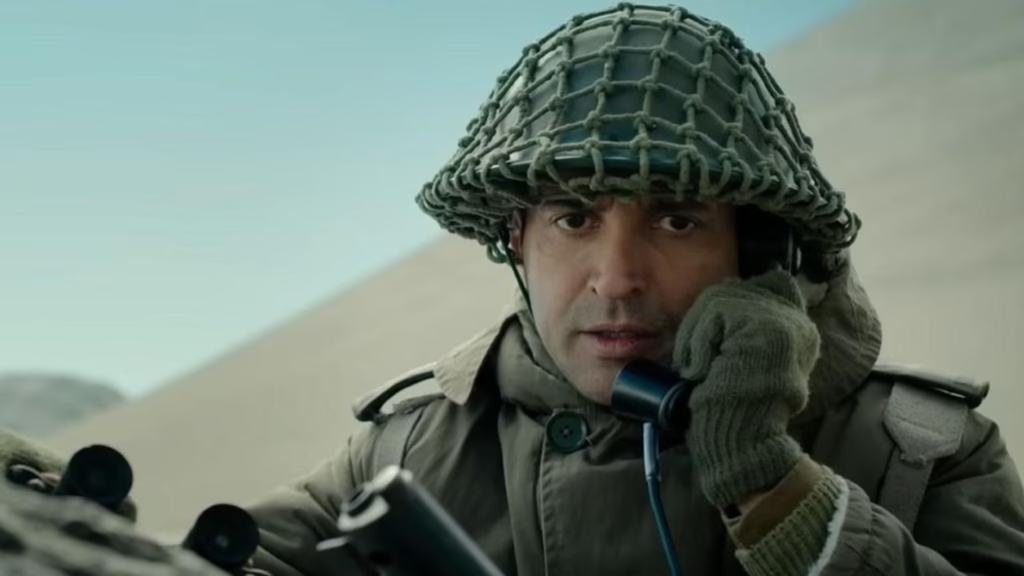
War films in Bollywood come with a kind of responsibility. They are not just tales; they become a lesson in sacrifice and courage and history. When a film promises to showcase a true incident that occurred during a war, the expectations automatically rise. 120 Bahadur, by Razneesh Ghai, also arrives with that kind of weight and promise. Starring Farhan Akhtar in the lead as Major Shaitan Singh Bhati, it revisits one of the most inspiring yet lesser-known battles from the 1962 Indo-China war: the Battle of Rezang La.
This is a story that deserves to be told, and the intention behind 120 Bahadur is noble. But often, the execution does not rise to the level of emotion and depth that this tale needs to make it unforgettable.
A Story Rooted in Sacrifice: The Battle of Rezang La
The heart of the film was the true and unimaginable bravery shown by 120 Indian soldiers of the 13 Kumaon Regiment. At an altitude of over 16,000 feet in freezing and life-threatening conditions, these soldiers were heavily outnumbered. More than 1,000 Chinese troops advanced towards them, but the Indian side showed their mettle and stood their ground, defending their nation until their last breath.
Out of 120 soldiers, 114 were martyred in this battle. Later, their sacrifice received the recognition and respect it duly deserved, and Major Shaitan Singh Bhati was posthumously awarded the Param Vir Chakra for his exceptional leadership and bravery. The emotional weight of this true story forms the backbone of 120 Bahadur, and at several moments, the film does manage to make you feel the pride and pain attached to it.
The strongest achievement of 120 Bahadur must be its visual authenticity. Not relying too much on CGI, the team shoots in Ladakh’s actual terrain, and that pays off beautifully. The snowy mountains, harsh wind, and frozen earth become silent characters throughout the film, reminding the viewer how unforgiving the battlefield truly was.
The war sequences feel gritty and genuine. The scale, the camera work, and the production design come together in creating an atmosphere where the audience can almost feel the cold and fear of the unknown. It is during these sequences that the film feels alive and powerful.
There’s no romanticism of combat brutality here. The movie shows bodies scattered on icy land, uniforms drenched with blood, and the haunting moments of silence after the chaos has taken its toll. At moments, soldiers write letters to the loved ones back home, knowing they may not ever return themselves. These scenes are emotional and so unbelievably grounded that viewers have to stop and think about the human cost of war.
The film also points out how ill-prepared Indian troops were in terms of equipment and resources. They lacked even the basic artillery, winter clothes, or sufficient food supply—yet their spirit never wavered. This candid truth brings gravitas and respect to the tale.
Underdeveloped Characters and Weak Emotional Build-Up
A war film is remembered when audiences begin to relate to the soldiers, not merely as warriors but as people with families, personalities, and dreams. Unfortunately, this emotional layer is missing. The efforts to depict friendly banter and personal histories among fellow soldiers appear rushed and sometimes even a bit awkward. Rather than adding to the depth, these scenes merely fall flat and disappear from memory all too quickly.
Farhan Akhtar’s character required more layered writing since it is the central character of the film. Though his effort and sincerity are quite visible, the role did call for a stronger emotional appeal and commanding presence. Viewers may find themselves imagining someone like Ajay Devgn, who naturally carries the intensity in patriotic roles.
The pacing of the film falters. When tension suddenly rises in a battle scene, all of a sudden, the plot jumps to emotional flashbacks with Major Bhati and his wife, played by Raashii Khanna. The transitions are forced, making the grip created by the rhythmic war sequence snap repeatedly. Rather, these transitions dilute the emotional impact and make the whole narrative feel stretched.
Predictable Writing and Over-the-Top Dialogue
Another weakness is the reliance on familiar patriotic tropes. There are scenes when the dialogues sound too dramatic and loud, instead of powerful and natural. A story that inherently has so much emotional load needed subtle writing. Even the opposing Chinese side is portrayed one-dimensionally, almost in a cartoonish way that takes away any nuance and realism from the conflict.
Music, Technical Craft, and Performances
The background score, which should, in ideal situations, elevate the emotional peaks, is surprisingly ordinary. It supports the storytelling, but it doesn’t leave much of a mark. Editing could have been sharper to avoid these tonal breaks and pace issues.
The performances of the supporting actors are earnest, but the script doesn’t allow them to shine. Farhan Akhtar, who does a sincere performance, seems to underplay the emotional intensity required for his role. Verdict: A Respectful Homage, Not a War Film for the Ages 120 Bahadur is a film with its heart at the right place. It salutes Indian soldiers who showed unbelievable bravery, and it highlights a part of history of which most people would remain unaware. Beautiful locations, realistic war scenes, and an emotional theme provide a lot of moments that linger on: But in the most important areas—character depth, writing, and emotional connection—the film falls way short. It feels very sincere, but sincerity alone cannot carry a story this big. For a theme full of bravery, pain, and national pride, it deserved far better storytelling.
Web Stories
Top 5 OTT Releases to Watch in November 2025
7 Times Hindi Cinema Took Justice to Court—Watch These Before Haq
Top 6 Bollywood Action Franchises You Must Watch in 2025
From Debut to Depth: Ananya Panday’s 5 Must-Watch Performances
Satish Shah’s Comedy Legacy: Smiles We Still Carry
8 Hindi Dramas That Feel Like Home
5 Ashok Kumar Films That Still Touch the Heart
7 Abhishek Bachchan Films That Hit Different on OTT
Rekha Ji’s Birthday Special: Films That Made Her a Legend
9 Youth-Based Indian Shows That Still Live in Our Hearts
Top 10 Contestants: Rise and Fall
K-Drama Royalty: The 10 Richest Korean Actors of 2025
7 Cameos Made the Movie Feel More Special
TV That Raised Us: 7 Reality Shows We’ll Never Forget
From War 2 to Saiyaara: Bollywood’s Day 1 Blockbusters

 By
| November 21, 2025
By
| November 21, 2025