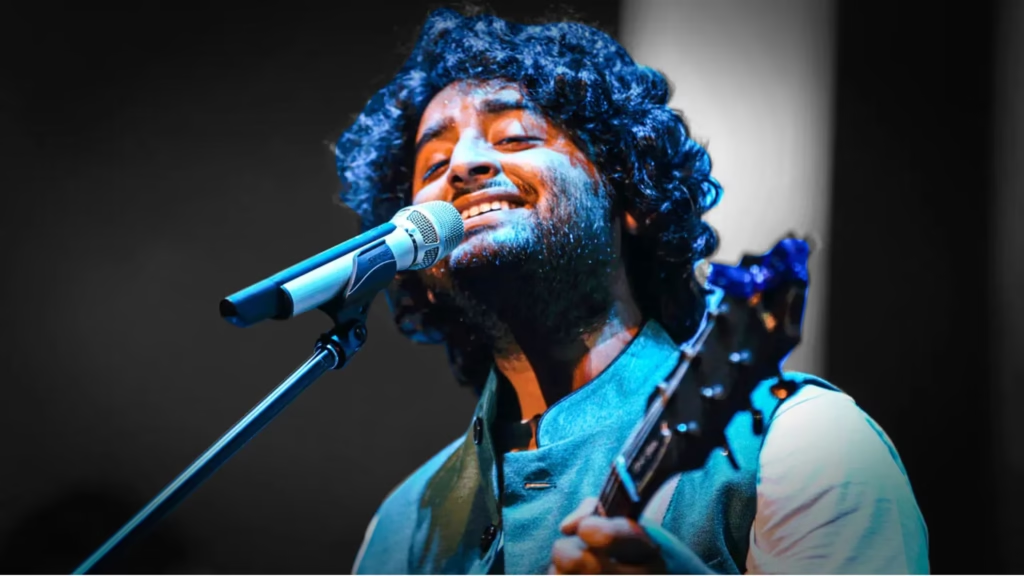
It was the news, a kind of stop-loss in the incessant beat of Bollywood. To millions the shockwave at the first day of 2025 turned out to be not about celebrations, but about the voice that has been playing the soundtrack of our lives since the dawn of the previous decade. Arijit Singhretires playback: he wrote in a simple, heartfelt message on the Internet. No theatrical publicity stunt, no oblique send-downs–a simple and solemn statement that was deeply personal. At that time a general murmur of Why? resounded throughout the land.
The importance of what Arijit Singh can say in the modern Indian film and its audience can hardly be overestimated. He was not only a singer, but also an emotion, a container of the unsaid in thousands of love stories, heartbreaks, and happy moments. His announcement is not only a change in his career, but it is also the sorrowful end of a cherished book in our cultural annals. Playback singing now has a before and after and Arijit will always be the after of generations.
Although we see this decision as abrupt, it must have been in the mind of the artist. Arijit in his frank-follow-up posts disclosed the desire that many of the best artists have but rarely acknowledge the necessity to reinvent themselves creatively. He talked of boredom and of the guts it required to place this call and most fascinatingly about a burning desire to go back to his origins. The man, who brought us the most contemporary, romantic and soulful anthems, is now responding to the call of the classical, to find consolation and new challenges outside the walls of the film studio.
The Voice That Made a Generation: A Return to the Meteoric Rise of Arijit.
We must travel back in time to the place where we originated at least most of us and see what weight this retirement has come to bear. The voice of Arijit Singh was a new discovery that was thrilling before he declared his retirement due to playback singing. He had previous appearances, but it was the tsunami of Tum Hi Ho in Aashiqui 2 that was able to irredeemably alter the landscape. The song has not only been a hit but it was a cultural reset. It proclaimed the coming of a voice that was exposed, coarse, and unbelievably harmonious, and pierced the racket to address the heart itself.
What ensued was ten years of unrivaled supremacy. The range of Arijit was staggering, between the heart-felt desperation of Channa Mereya and Phir Bhi Tumko Chaahunga and the innocent playfulness of Badtameez Dil and the peaceful love of Muskurane. He might be the man who croons Gerua in a road trip, the man who begs in ae Dil Hai Mushkil, or the man who is swelling with pride in the song Soch Na Sake in airlift. The filmmakers made his voice the standard language of emotion, which promised emotion and connection.
Formal recognition of this impact is his shelf of awards, of which two National Film Awards and the Padma Shri are the main ones. However, his real prize is the place that he takes in our own memories. Who amongst us has not resorted to an Arijit Singh song to heal a heartbreak, glorify a love or just to feel it a little less lonely? He gave the background music to our first love, our college life, our lengthy drives, and our deep thoughts. This is such an intimate attachment and the reason why his retirement is more of an update about the industry than a personal good-bye.
Interpretation of the Announcement: What was the Reason behind this landmark Decision?
Arijit Singh, who recently declared that he was retiring to playback singing, had been asked by fans the agonized question of why as soon as he announced it. Luckily, as usual, in his unedited style, Arijit provided more insight than most retired celebrities. He has broken down the concept of one dramatic cause, rather creating a portrait of an artist in a place of creative intersection. The motivations he has given are an interesting revelation of the mind of a holistic artist, who has achieved the heights of commercial success.
He mentioned mere boredom, the desire to have new musical challenges. It is not an indication of lack of respect in the playback, but a natural scratching of a creative soul that has achieved one thing and longs to do it all. The fact that he always varied his own hits to perform live was a warning sign early in his career, a desire to find something new in something familiar. Additionally, he was enthusiastic about hearing a new singer, which would bring genuine motivation, which is exceptionally modest and prospective and wishes the industry to improve.
His evident direction perhaps is the most pertinent reason, and the most comforting to his followers. Arijit Singh does not give up music, but he retires out of playback singing in order to rediscover it. His statement, I will go back to Indian Classical Music is a kind of homecoming. It is a throwback to the disciplined, religious, and unlimited shastrija sangeet, the very source that provided his playback voice with its incomparable texture, control and emotional genuineness.
The Fallout: How India Reacted to the News and Fanfare.
The cyber world was a direct mirror of a shaken heart of a nation. The social media networks, in particular, X (previously Twitter) and Instagram, became a virtual meeting place of grievers, well-wishers, and nostalgic fans. Meshes crying out Kehdo account hacked hai (Please say the account has been hacked) went viral along with emotional messages describing his voice as the soul of Bollywood. The internet shared its loss and spent a few hours scrolling through the playlists, sharing their favorite memories of Arijit.
Such a response is indicative of a crucial reality: the relationship of Arijit Singh with his audience was very personal. He was not a faraway star but we heard his voice and especially in moments of our personal life. It was not only a cry of losing a great singer but also about the fear of losing that friend. It raised debates on the pressures of being a star, the necessity to be free to create art and even the present position of Bollywood music with many questioning whether the industry could or would ever be able to give birth to or sufficiently substitute a talent as he had.
But through the melancholy ran a fiber of insight and admiration as well. The decision was pure to many fans particularly those who had knowledge about his classical education and his philosophical interpretations of music. They did not perceive it as a desertion, but as a pilgrimage. The mood changed to Don’t go, to We will miss you but do what makes you happy. Such a mature fan-artist relationship is the attribute of the true bond he developed in his art and his true personality.
Outside Bollywood: The Question of What It Means to Go Back to the Indian Classical Music?
It is a new exciting chapter that opens not only to Arijit Singh, but to the classical art in India, when he declares his retirement as a playback singer to start his career in the Indian classical music. It is not a hobbyist retreat; it is a prodigal son going back to his guru. The base of Arijit lies on classical training by the revered tutors. It is a gesture that indicates a wish to eliminate the levels of arrangement, time pressures and movie-making requirements to approach music as it is most fundamental, as it is most basic, as it is most disciplined and as it is most expansive.
This could be a watershed moment of Indian classics music to the world. Arijit Singh is taking with him a huge and young mainstream that may not have been exposed to the finer aspects of a khayal or a dhrupad. His introduction into this space may serve as a bridge to expose the millions of people to the beauty deeper than raga and taal. The potential is immense: close baithak concerts are broadcasted live over the Internet, collective albums with legends, or even a hybrid genre, which introduces classics to mass culture.
He says, I will make my own music, and it guarantees an intriguing synthesis. We would watch the birth of a new Arijit Singh -a composer, a creator, a curator of sound that is free of the three minute film song format. This may result in the independent albums, experiments, and the works of pure expression of his artistic idea that are not tied to box office success or to directorial mandates. The suspense is felt by anyone who appreciates artistic development.
The Legacy and The Road Ahead: Filling an Unfillable Void?
The immediate practical question of Bollywood will be, of course, What now? The industry has been over the last several years dependent on the voice of Arijit. He leaves a vacuum with his retirement, it is a hole too big to be filled by any one voice. This is an opportunity though, that may trigger much-needed diversification. It may even compel music directors to find and develop new talents, to experiment with various textures of the voice, and to distribute the mic more freely. Opportunity is a challenge.
It is a bitter moment to the future singers. On the one hand, they lose an idol and a point of reference but on the other hand, they are provided with a landscape that has an extra place to go high. The very desire of Arijit to be inspired by a new generation is a blessing. The future may be competitive, but it may also be more diverse and bigger, with a richer pile of voices to shape the next ten years of Bollywood music, similar to the one that succeeded the golden age of Kishore Kumar and Lata Mangeshkar.
In our case, as the audience, what we have are treasures. Hundreds of songs which will keep on scoring our lives. Whenever Tum hi ho will be played, it will be accompanied with another layer of nostalgia. Any version of Channa Mereya will be a treasure of a golden era. Arijit Singh retires as a playback singer but his voice is permanently imprinted in our personal and national history. It is not the voice we are saying good-bye to, it is a gift of the voice, which is the memories; and we wait with excitement the sage, the classical student, and the independent artist which it will become. The journey is not over, it is merely going on a very beautiful, unexpected trip. And, signing up with his own hand, perhaps with a twinkle in his eye, Arijit himself, “Ab aayega maza! In fact, the actual fun has yet to start.
Web Stories
Top 5 OTT Releases to Watch in November 2025
7 Times Hindi Cinema Took Justice to Court—Watch These Before Haq
Top 6 Bollywood Action Franchises You Must Watch in 2025
From Debut to Depth: Ananya Panday’s 5 Must-Watch Performances
Satish Shah’s Comedy Legacy: Smiles We Still Carry
8 Hindi Dramas That Feel Like Home
5 Ashok Kumar Films That Still Touch the Heart
7 Abhishek Bachchan Films That Hit Different on OTT
Rekha Ji’s Birthday Special: Films That Made Her a Legend
9 Youth-Based Indian Shows That Still Live in Our Hearts
Top 10 Contestants: Rise and Fall
K-Drama Royalty: The 10 Richest Korean Actors of 2025
7 Cameos Made the Movie Feel More Special
TV That Raised Us: 7 Reality Shows We’ll Never Forget
From War 2 to Saiyaara: Bollywood’s Day 1 Blockbusters

 By
| January 27, 2026
By
| January 27, 2026